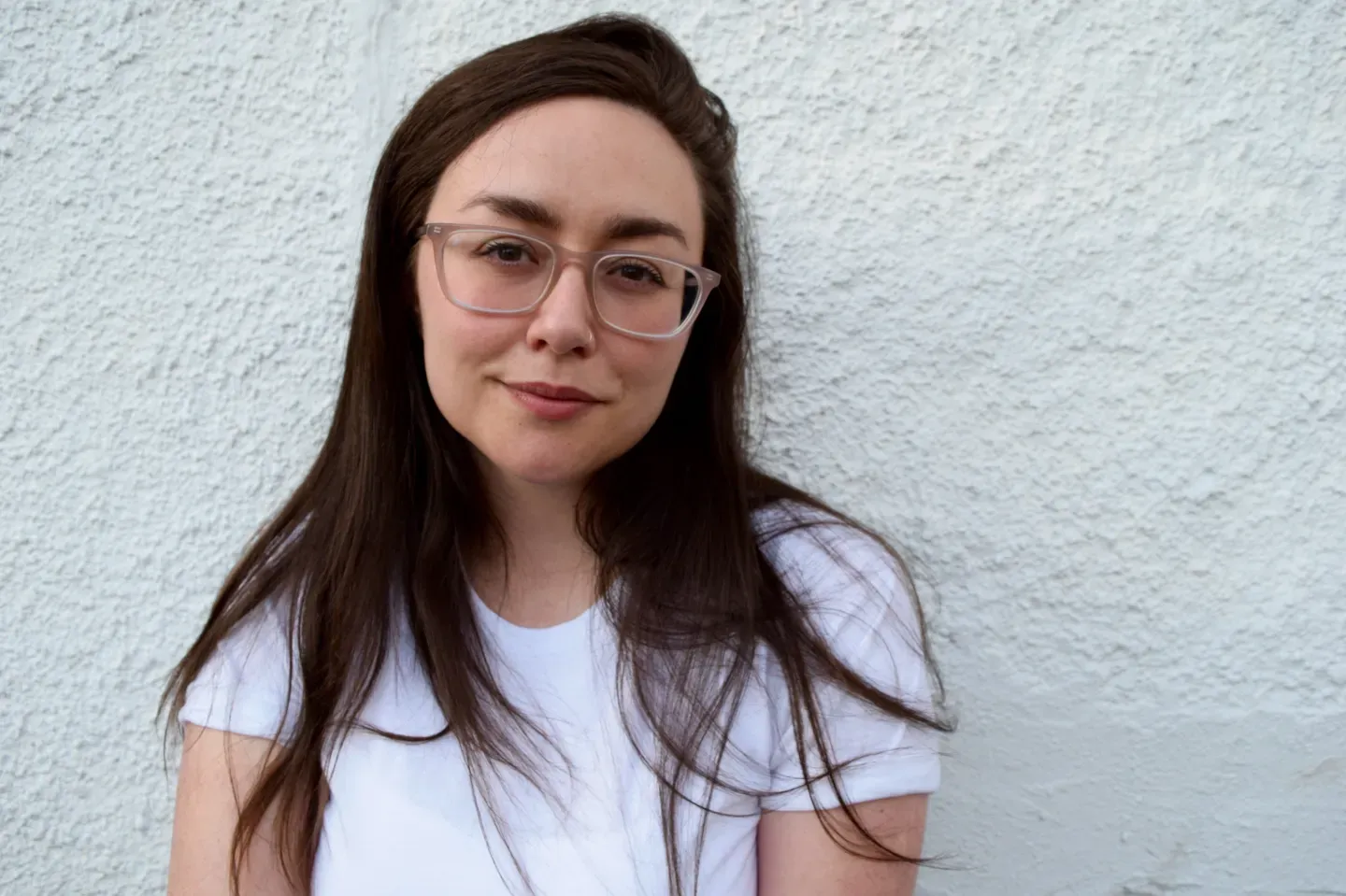
An Interview with Caylin Capra-Thomas, Conducted by Anna McCluskey
What got you into writing?
Even though I’m not a fiction writer, I’ve always liked to tell stories and read stories since I’ve been able to talk. There are some old home videos of me in the late eighties in my pajamas on the fireplace treating it like a stage and telling really gruesome horror stories. Always about death and destruction. There’s this family famous clip where I’m standing there and going- “There were two cars and they crashed. And there was blood! And it got all over daddy! And it got all over me!”, in my little kid lisp. Narratively, I can’t really say that it was particularly skillful, but I did like to tell stories. Before I could write I would dictate stories to my dad.
What was the inspiration behind Iguana Iguana?
I didn’t really set out to write Iguana Iguana. I was writing poems for that collection over a span of seven years of my life and I’d say maybe a third of it appeared in my thesis in some form or another. I was like, “well, I got quite a lot of poems here and these all seem to be of a set’, and Sebastian, who was the editor, contacted me and asked me if I had a book. I was like, I’ve got this manuscript of poems that I believed wasn’t actually a manuscript except for my wanting it to be. So I sent it to him, sort of recalibrated it: I hadn’t looked at it in awhile because I had written a book in between... Poetry is a labor of love. A lot of first books come out on the contest model, where a publisher opens up a contest where people can submit to it [the contest] with a fee. Those contests might publish two or three books out of the submission pool, which could anywhere from four hundred to one thousand manuscripts. I was submitting to all these contests and I was getting just enough positive reinforcement in the form of being short-listed or placing as a finalist to keep me submitting, but I never got any feedback why it never made it past the line besides just sheer numbers. So I pulled [my manuscript] out of the game like “clearly the poems in here are worthwhile, but there’s something about the way its sitting together as a while that it isn’t quite cutting through the cluster. Sebastian, being the new and sole editor for a new poetry series at this press had the time to say “hey, this is what I see in this and this is where it could go,” like, he had time to give me feedback, which is what I needed. For Iguana, Iguana, it was just writing poems for close to a decade and at the end of it I was like, “Well, what do we got here? What can we make of it?”.
Were there any challenges with the making of Iguana Iguana?
In the individual writing of the poems I think there’s always the challenge of fallow periods where its a little less natural to switch your writing brain on, and that usually happens when I’m not reading enough. Or when I’m only reading things like reading a bunch of first year composition essays. Then it can be really hard to turn on your writing, or poetry brain on. People also just have this mythical idea of the depressed writer being able to mine their mental illness for material, but I kind of found fallow periods also snapped onto periods of greater emotional intensity in a way that would maybe disprove that. Life gets in the way. Having to earn money gets in the way. American Capitalism, I guess, gets in the way. All of those things that aren’t writing that you have to do just to maintain your biological functions. That can be kind of a drag and a drain on the art spirit. I think the hardest part is just getting yourself to the page and getting over the voice in your head that’s like “I don’t feel like writing,” and even when you start and you’re making yourself do an exercise... just being tired or overworked... its getting out of your own way, basically. Getting out of your head and letting yourself write badly.
What does your writing process look like?
It really depends on what it is. I think the best feeling in the world as a writer is when you want to write. It’s “I want to write” to “Hey, I am writing! And I like this!” And that, I find, in my middle age where I have competing claims on my time and more external stressors, there isn’t as much room for that to happen, so I do kind of find myself having to engineer the inspiration. It’s not always the case that I am poetry mode or in writing mode all the time because it’s much easier to come home and melt into the couch and have a Simpsons marathon or something. But when I have more generous pockets of time like in the summer, I tend to find inspiration or drive more organically. Being somewhere, or when I’m going somewhere else always makes me want to write. But no matter where I live, leaving is seeing something different. I need a balance between structure and routine and novelty, because without the novelty I’m going to get bored but without the structure and routine I’m just never going to do it. Sometimes just sitting down and reading good poems will make me want to write. If I need to engineer some inspiration, I read whatever genre it is I’m trying to write, read something that I know is going to make me feel homey, or otherwise I have a writing group that meets once a week and that also is kind of the only thing that has been getting me to the page regularly when school is in session.
How long did it take you to write Iguana Iguana? How long did it take to get published?
The oldest poem from the manuscript might be from 2014 and the ‘youngest’ poem in the manuscript is from maybe January 2021. So that’s about seven years. Some of them are more memorable or recognizable. I can remember poems, like where I was when I was writing them. Sebastian reached out to me in the Fall of 2020, I believe it was October or November, maybe? I sent him the manuscript and then we had a conversation a couple weeks later and that’s when he gave me feedback to help me make it more of a coherent, solidified thread of the book. I actually wrote nine poems in about a week, and I think seven of them actually wound up in the manuscript. I sent Sebastian the final revision in early 2021 and that spring we hammered out a contract in July of 2022. So it was about a year and a half between submission and publication.
What is your favorite piece of literature?
Oh, that’s hard. There are many. It’s sort of impossible to select a favorite. I think it depends on the day and I also think that you’re a writer you’re a lover. And I feel that, as writers, and as book lovers, we become sort of internally composed of all of our favorite books and all our favorite lines. There are probably like ten or fifteen poetry collections that I read one spring, and I would randomly have Fridays off, so every Friday I would read a book of poems cover to cover out loud, and then when I was done I would write down words that stuck out to me. There were books that were very memorable that I remember from that time period that aren’t necessarily my favorite books, but they were part of some of my favorite moments of my life. However, all of that said, Ada Lamons’ “Bright Dead Things” was a formative book. Louise Blicks “The Wild Iris”. Mary Shelley’s “Frankenstein”. I’m a big Mary Shelley- Mary Wollstonecraft girly. The fun of it, especially a couple hundred years later, where, I felt when I was younger I felt like it wasn’t cool to like things- or cool to be fusive or non-dramatic. And maybe melodrama's never cool, but looking back on it, the earnestness with which some of these characters say the most bananas stuff is wonderful. Robert Walton, the guy whose writing the letters (in Frankenstein) and telling the story within the story- the love that he professes to Doctor Frankenstein- I think that is funny! That’s part of what I like about it. I always get a little stressed out about favorite book questions because I leave the conversation and then I’m like- ‘Here’s twelve books that I love!’ that I didn’t honor in that response! I always feel like I’ve done twenty writers that I love dirty.
What would be your one tip of advice for new writers?
Just one? I feel like I’ve gotta weigh my options. I guess, follow your curiosity and follow the writing. A lot of times people sit down at the page and think, ‘I want to write a poem about grapes.’ or ‘I want to write a poem about candy corn.’ and when you do that you might be limiting yourself to all that could potentially be said about candy corn or grapes and limiting the extent to which an interesting candy corn or grapes could lead you to something else. Either the source of that interest or another weird thing that you didn’t know that the exploration of those original, originating topics would reveal to you. I think cultivating your curiosity and maintaining your awareness of your own mind and really listening to your mind when it hitches on something. Question why you noticed it. Interrogate it. ‘Why did I notice this bowl of candy corn?’ And for context, there’s a bowl of candy corn right here on the table, which is why I keep talking about candy corn.
If you had to pick a fight between one Goliath sized chicken or ten chicken sized Goliath's, what would you pick and why?
Are we talking about the biblical Goliath? I was not brought up in a church, so I’m like, “Which one was that one?”. He was big, right, right. So, a goliath chicken, so a chicken that is enormous- I do not want that one. Because that’s terrifying and chickens are dinosaurs, so that’s basically a T-Rex. A goliath chicken. Scary. However, staying with the dinosaur theme, ten chicken sized goliaths- I mean like, there’s strength in numbers. It might be a losing battle either way. Do you want to die a death of a thousand cuts? Or do you wanna die in one quick blow? Like, I think I’m going down either way. So it is a question of if I would rather be killed by a giant chicken or ten little monster men. I guess I’m gonna go with the goliath sized chicken.
Anna McCluskey is a junior at Waldorf University, double majoring in Theatre Management and Creative Writing. She is super excited to be submitting to the Waldorf Literary Review once more!